The celebration of Native American Women Directors expands with a short films program featuring the works of Native Women and is followed by a discussion with Michelle Hernandez and Jennifer Varenchik.


First Nations Film & Video Festival
THE OTHER 51%: Native American Women Directors
Thursday, November 6
RSVP FOR FREE
Showtimes
Thursday, November 6
7:00pm – Short Film Program
8:30pm – Discussion
Ticketing
Free with RSVP
FACETS Members save 15%
Not a Member? Sign up today!
RSVP FOR FREE
Jane & the Wolf (9:45)
“Jane & the Wolf is a hybrid documentary that incorporates cinéma vérité, archival photographs and animation. In the 1960s, Pagwa River was a booming railroad town populated by 2nd generation Crees. During one cold winter, the community was being stalked by a lone wolf. Every attempt to kill the wolf failed. Jane recognized the wolf as a spirit sign from the ancestors. Ridiculed for her beliefs, Jane set out alone to killing the wolf using the old ways.
Narrated by Jane’s Great Granddaughter Rachel Garrick, Jane’s story is interwoven with Rachel’s own journey to bring her mother Minnie Garrick to her final resting place. Minnie was a story teller, a surviver, and a woman who reclaimed her life despite many personal challenges. Minnie had passed on the story of Jane to Rachel at a time in her life when Rachel most needed to hear about the strength that is inherent in their family.
Directed by Nadine Arpin (Métis)
She is Water (13:00)
Mary, an Ojibway teenager is taken by a stranger after a day out with her friends. She returns to Mother Earth and the Natural World seeks retribution.
Directed by Darlene Naponse (Ojibway)
Battles (3:42)
At nightfall, Karen decides to leave the party where a friend is in the process of losing herself. A life metaphor, this battlefield.
Directed by Karen Pinette Fontaine (Uashat)
In Our Own Hands (11:00)
A group of women plan rescue efforts when one of their own goes missing from their reservation.
Directed by Jennifer Varenchik (Tohono O’odham)
Nothing about Moccasins (3:42)
There will be no film on moccasins.
Directed by Eden Mallina Awashish (Atikamekw)
Raven (10:46)
A woman contemplates suicide and decides that her life is worth living after all. After arriving on her motorcycle in the snowy woods, she finds a beautiful but lonely tree where she gets lost in the moment of a decision she has been struggling to keep and experiences an ethereal dream where she comes face to face with the little one that could have been.
Directed by Razelle Benally (Diné / Oglala Lakota)
THE SHORT CUT (10:42)
A teenager is running late for his curfew. And is informed about another missing girl in the community. While taking the short cut home he is stalked by a paranormal force. And he encounters two men disposing a body. The film was shot in Canada, NS, Cape Breton Island, 2020. This film is shot on the Iphone XR.
Directed by Dawn Wells (Canadian Mi’kmaq Aboriginal)
The Daily Life of Mistress Red (10:33)
The Daily Life of Mistress Red is a mockumentary that explores the world of kink, native women and defeating white supremacy on one’s own terms. Taylor is a blogger for an Indigenous women’s website and wants to interview her favorite idol Marie Callingbird; a Native fashion boutique owner by day and to her surprise, Mistress Red. This project focuses on issues within the circle of indigenous women, racism and the acceptance of sexuality. This story follows a journey or what sexuality is to indigenous women and what it can do to empower them.
Directed by Peshawn Rae Bread (Comanche)
Self Portrait (3:15)
Struggling with gender identity, sexual orientation, and cultural identity has been a normal aspect of my life. Being pulled in and out of native culture and feeling like my queerness was unwelcome by my people, I separated myself for years. Now I explore my relationship with my culture by decolonizing myself and others by sharing my identity openly and honestly.
Directed by Faun Harjo (Muskogee)
Postcards (3:20)
I went on a trip out west two summers ago. We hit major national parks and monuments. One week from Norman to Southern California, and one week back. Every time we stopped I bought a few postcards. Sorting through them I realized I had only bought portraits of Native American leaders, national park advertisements, and wildlife/landscape photos. I saw the thin white line between what was a conservation effort or assimilation effort by the government.
Directed by Faun Harjo (Muskogee)
Douk (16:31)
A Native American family confronts the harsh reality of being split apart from their daughters.
Directed by Michelle Hernandez (Wiyot)
PANELISTS
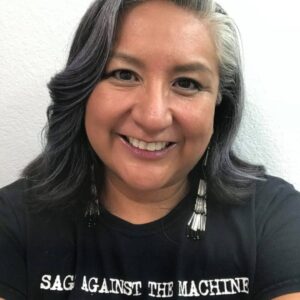 Jennifer Varenchik (Tohono O’odham)
Jennifer Varenchik (she/her) is from the Tohono O’odham Nation of Arizona. She is writer and director who started as an actress, before moving behind the camera to create more accurate depictions of Indigenous people. Jennifer’s training includes improv at The Groundlings Theater, acting at Stella Adler Academy of Acting (Los Angeles) and screenwriting at Long Beach City College. She has written and directed several short films, commercials and PSAs. Jennifer resides Kaneohe, HI and in January 2021, she won the Hawaii Filmmakers Collective Pitch Contest to complete her short film “In Our Own Hands”.
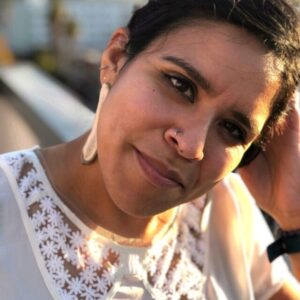 Michelle Hernandez (Wiyot/Latina)
Michelle Hernandez is a Wiyot and Latina filmmaker. She grew up on the Table Bluff Reservation, where she found her love for filmmaking. She has a Masters in Film and Electronic Media at American University in Washington, D.C. and a B.A. at Humboldt State in both Film and Native American Studies. Much of her work focuses on the importance of culture, traditions, and identity, as well as dealing with Indegenous subjects. With her work she gives voice to stories that aren’t often told. She is the co-founder of Sugarbush Hill Productions, which she currently runs with her partner, Richie Wenzler. Her latest works include Douk and The Bartow Project.
Director: The Little Deer Killer, Douk, The Bartow Project “Untitled” (Still in Production)
35TH ANNUAL FIRST NATIONS FILM AND VIDEO FESTIVAL
First Nations Film and Video Festival, Inc. (FNFVF) is a 501(c)(3) tax-exempt nonprofit organization dedicated to supporting Indigenous cinema. As the host of Chicago’s largest Native American film festival, FNFVF has become the leading resource in the region for Native-produced films and is trusted by Native American filmmakers as the premier platform to bring their work to the screen.